 Spookyswap
 V3 Fee Tier Selection for Token Pairs
Spookyswap V3 fee-tier selection starts with relative price behavior, then weighs the trading volume and active liquidity available in each pool. The documented options are 0.01%, 0.05%, 0.30% and 1.00%. Lower tiers generally suit closely tracking assets, while higher tiers seek to compensate providers for greater relative price risk. Different tiers identify separate pools for the same pair, so liquidity can split across competing markets. A provider earns from trades using liquidity inside the selected price range. For traders, the relevant comparison is the quoted output for their amount after pool fees and price impact.
Fee Tiers Define Separate Pools
Pools containing the same two tokens form separate V3 markets when their fee tiers differ. A fee tier specifies the percentage the pool charges on swap input. It does not describe an annual return on deposited capital. Selecting a tier selects one of these markets, with its own liquidity and trading activity. Positions in different tiers do not share one combined fee balance.
Asset correlation describes how closely prices move together. The relevant risk concerns changes in one token’s price relative to the other.
Lower Tiers for Closely Tracking Assets
Lower V3 tiers target pairs whose relative prices usually change little, leaving limited compensation for liquidity providers per swap.
The 0.01% Tier
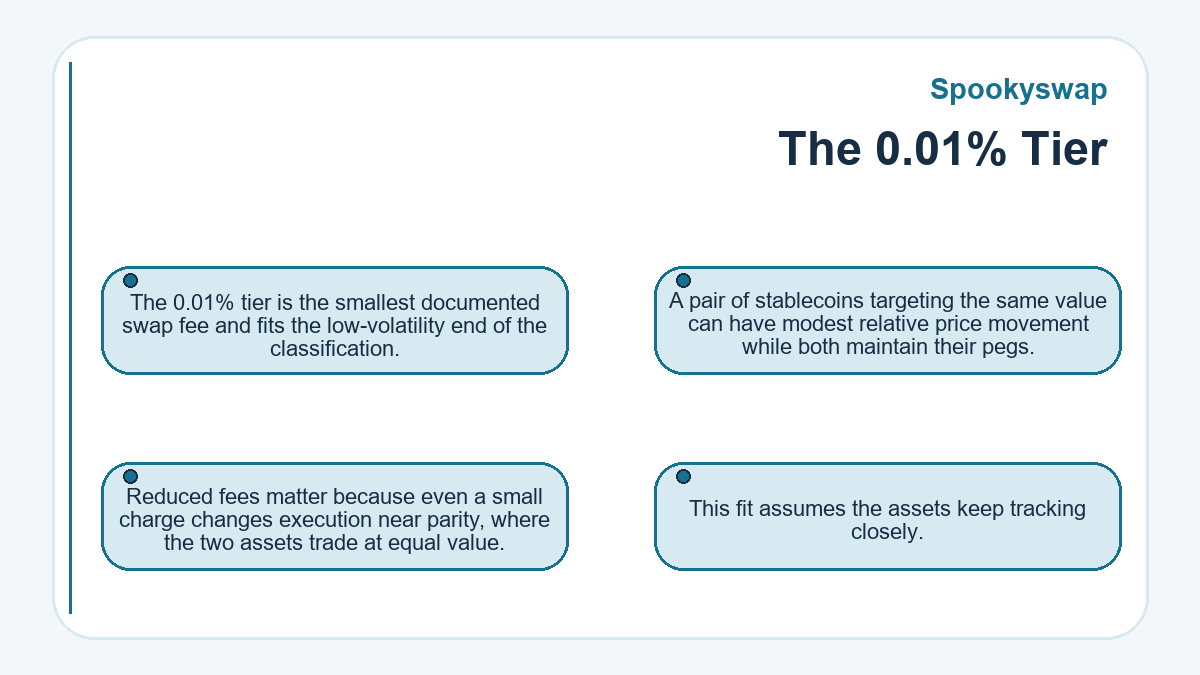
The 0.01% tier is the smallest documented swap fee and fits the low-volatility end of the classification. A pair of stablecoins targeting the same value can have modest relative price movement while both maintain their pegs. Reduced fees matter because even a small charge changes execution near parity, where the two assets trade at equal value. This fit assumes the assets keep tracking closely.
The 0.05% Tier
The 0.05% tier is another lower-fee option for like-kind assets, meaning assets expected to track similar values. It charges more per swap than 0.01% while retaining a small percentage fee. Neither category determines which pool traders actually use. A closely tracking pair may have meaningful liquidity in one lower tier and little usable depth in another.
Higher Tiers for Relative Price Risk
Greater relative price movement changes a liquidity position’s token proportions, giving higher swap fees a possible role in compensating providers for that exposure.
The 0.30% Tier
The 0.30% tier sits above the two lower-fee choices and is a candidate for pairs with less closely related prices. Trading shifts the position’s token proportions as the relative price moves. These changes can create impermanent loss, a shortfall against holding the original tokens before counting trading fees. Fee income may offset this shortfall, depending on trading volume and the position’s active liquidity share.
The 1.00% Tier
The 1.00% tier has the largest fee in the documented menu. Exotic or infrequently traded assets may fit this category because providers accept greater holding risk or fewer fee-generating trades, although a larger charge per trade can also make another available pool more attractive to swappers. Sparse trading can leave a high-fee position with little revenue.
From Pair Selection to a V3 Position
The liquidity form connects the pair’s fee classification to a specific pool and the price range to that position’s active prices. This setup requires V3-compatible token behavior and a fee tier enabled on the selected network. Pair and tier selection precede range selection, token authorization and the deposit.
| Stage | Action | Position Effect | Needed Before Proceeding |
|---|---|---|---|
| Network and Pair | Select the network and two tokens. | Identifies the intended market. | A connected wallet on a supported network and V3-compatible tokens. |
| Pool Fee | Select an enabled V3 fee tier. | Identifies the pool for the position. | The selected token pair and a supported tier. |
| Range and Amounts | Set valid price bounds and deposit amounts. | Defines the liquidity allocation. | Bounds matching the pool’s tick spacing and sufficient balances for the required tokens. |
| Authorization and Preview | Approve token spending where required and review the deposit. | Prepares the intended deposit. | Completed position settings and gas funding for required transactions. |
| Deposit Confirmation | Submit the addition and check confirmation. | Successful execution creates the position. | Reviewed parameters and sufficient token authorization. |
| The tier identifies the pool; the selected range determines where the position can supply liquidity. | |||
Range Activity and Tick Spacing
A V3 fee tier affects the pool’s range granularity, while each position’s price bounds determine whether it earns swap fees.
Active Liquidity
Active liquidity is the capital available to trade at the pool’s current price. A V3 position stops earning swap fees while the pool price lies outside its selected range. A pool can hold substantial deposits across many ranges while only a portion supports trades near the current price, and each position’s fees follow its share of active liquidity along the prices the trade crosses. A narrow position may have a larger active share around selected prices, with greater exposure to becoming inactive after a smaller relative price movement.
Tick Spacing
Ticks are discrete price boundaries where liquidity ranges can begin or end. The Spookyswap V3 factory source initializes spacing to 10 ticks at 0.05%, 60 ticks at 0.30% and 200 ticks at 1.00%. The factory owner can enable additional fee-to-spacing mappings; each pool receives its spacing when the factory creates it. Position boundaries must align with the chosen pool’s spacing. Larger spacing gives fewer available boundary points over the same price interval.
Fragmentation and Quoted Trade Output
Liquidity fragmentation occurs when capital for the same pair sits in separate fee-tier pools. A trade uses the pools on its route, so liquidity in another pool does not automatically support its execution. Within a V3 pool, capital near the traded price matters more directly than deposits far outside it. A lower fee can lose its advantage when thin active liquidity produces greater price impact, the price change caused by the trade itself. A deeper pool with a higher percentage fee may then quote more output.
Quote comparisons need the same input token, output token and amount on the same network. Changing those inputs changes the transaction being priced.
Trading Fees, Protocol Shares and Farm Rewards
Swap-fee earnings depend on the amount traded through the position’s active ranges and its share of liquidity there. A higher tier takes a larger fee from the same swap input, while trading flow and competing liquidity determine the position’s actual share. The percentage alone cannot establish a profit rate.
An enabled protocol fee allocates a configured share of swap fees to the protocol. This share changes what remains for liquidity providers. The swap-fee tier alone does not indicate whether a protocol share is enabled for a particular pool.
Farm rewards add a separate incentive when a provider stakes an eligible V3 position’s non-fungible token (NFT) in the corresponding farm. A farm corresponds to a pool with a specific fee tier, so positions containing the same token pair can have different eligibility. The farm must also be active. Its reward rate does not replace the swap fee or show how much fee revenue the pool generates.
BOO staking produces an xBOO claim on the buyback pool. That participation is separate from the fee tier attached to a V3 liquidity position.
Pair Labels and Token Mechanics
Stablecoin pairs can lose their expected price relationship when an asset breaks its peg. A narrow position may then become inactive and end up holding one of the two assets. The pool keeps its fee tier as those conditions change, so an earlier low-volatility classification can stop describing its market.
Token mechanics impose another boundary on tier selection. Tokens charging fees on transfer do not work with the standard V3 router. A token wrapper or customized router may provide a workaround, with its own compatibility requirements. Selecting a higher pool fee does not create that workaround. A negative rebase can also reduce a provider’s assets when the position becomes active, independently of its selected tier. The pool provides no mechanism to recover that loss.
A Different Tier Means a Different Pool
A V3 pool’s swap-fee tier remains fixed after pool creation. A provider seeking another tier needs a position in the corresponding pool. Adjusting price bounds changes a position’s range, not the pool’s fee.
A destination pool has its own active depth, trading flow and any matching farm. Moving liquidity also incurs network transaction costs, which can reduce the benefit of pursuing a different percentage. A lower-tier pool offers a smaller charge per swap. A deeper higher-tier pool may attract more trading when its extra liquidity outweighs that charge in the quoted output.
Spookyswap: reader questions
-
Can I Choose a Fee Between the Documented V3 Tiers?
- A V3 pool must use a fee tier its deployment’s factory has enabled. The documented menu does not give liquidity providers authority to enable an arbitrary percentage. Additional tiers require the relevant protocol configuration; permission to create a pool does not grant permission to add a new fee level.
-
Does a Multihop V3 Swap Use One Fee Tier Throughout Its Route?
- Each V3 pool in a multihop route charges its own fee tier. A route can combine pools with different percentages, and its quote reflects their successive fees and price impacts. A liquidity position earns from trading in its own pool; activity elsewhere on the route does not add to that position’s fee balance.
-
Are Swap Fees Paid to V3 Liquidity Providers in BOO?
- V3 trading fees accrue in the pool’s two tokens, so BOO is a fee token only when it belongs to that pair. The direction of trading determines which token generates each fee. Farm incentives are a separate reward stream and can use a reward token different from the assets in the pool.
-
Is a Higher Fee Tier Also a Higher Slippage Tolerance?
- The pool fee and slippage tolerance control different parts of a swap. The fee tier sets the pool’s charge, while slippage tolerance limits acceptable changes between the quote and execution. Increasing that tolerance does not change the pool fee; it can permit less favorable execution within its minimum-output or maximum-input limit, depending on the swap type.
-
Will Choosing a full-range V3 Position Remove the pool’s Swap Fee?
- A full-range V3 position retains its pool’s fee tier. Full range changes where the position supplies liquidity, spreading capital across a broader price interval. It does not waive the fee for traders or give the position access to fee revenue from another tier.
Updated