 Spookyswap
 xBOO represents a share of BOO in the buyback pool
Spookyswap xBOO represents a proportional claim on BOO held in the buyback staking pool. Depositing BOO issues receipts at the pool’s prevailing exchange ratio, while completed fee-funded buybacks can increase the BOO redeemable per xBOO. Buybacks change each receipt’s backing without increasing the holder’s xBOO balance. Available partner pools can accept those receipts and pay separate reward tokens while their underlying buyback participation continues. The redeemable BOO amount, partner reward balance and BOO market price describe different parts of the position. A larger BOO claim can therefore coexist with a lower cash value when BOO’s price falls.
Depositing xBOO in a partner pool preserves buyback participation while adding that pool’s withdrawal dependency and separate reward terms.
Deposits and the BOO Backing Ratio
A BOO deposit receives xBOO in proportion to the pool’s existing backing, so the receipt amount follows the exchange ratio at deposit. For a funded pool with outstanding receipts, BOO per xBOO equals the pool’s BOO balance divided by total xBOO supply. Multiplying the receipts held by that ratio gives the corresponding BOO claim. When each receipt represents more BOO, an identical BOO deposit receives fewer xBOO tokens. The smaller receipt count still represents the deposited share of the pool.
New deposits increase both BOO reserves and receipt supply proportionally. Pool growth from incoming deposits alone does not create a buyback return for existing holders.
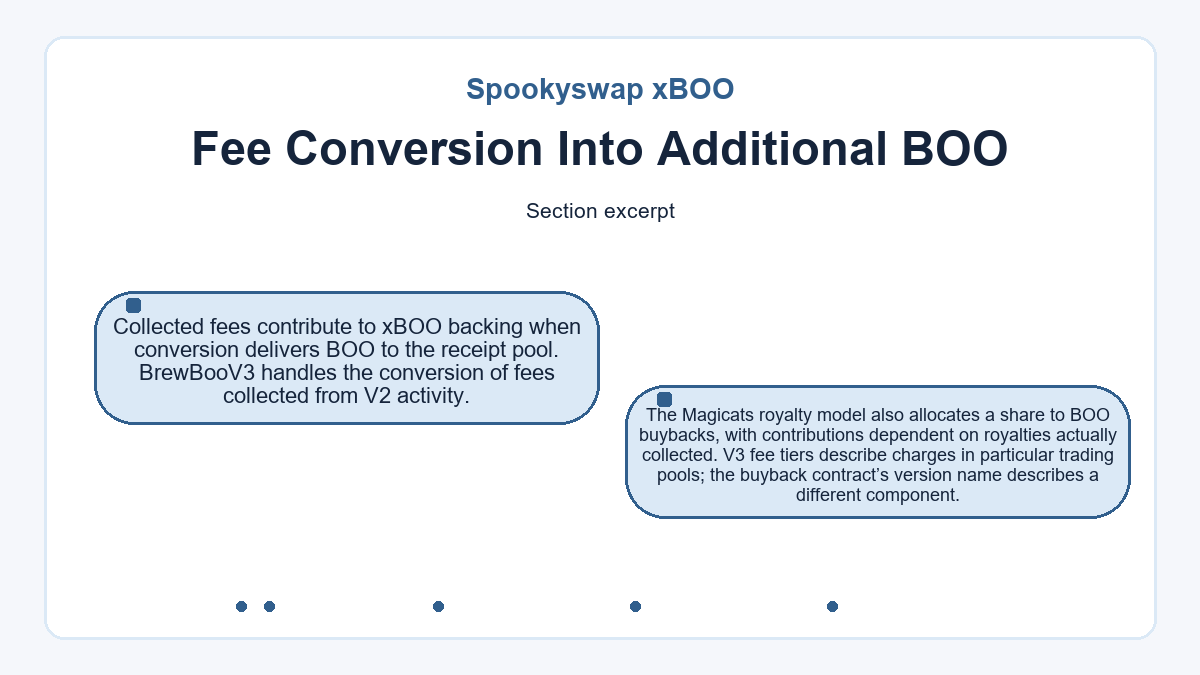
Fee Conversion Into Additional BOO
Collected fees contribute to xBOO backing when conversion delivers BOO to the receipt pool. BrewBooV3 handles the conversion of fees collected from V2 activity. The Magicats royalty model also allocates a share to BOO buybacks, with contributions dependent on royalties actually collected. V3 fee tiers describe charges in particular trading pools; the buyback contract’s version name describes a different component.
The conversion contract exchanges collected assets for BOO and distributes the resulting balance. The published BrewBooV3 implementation allocates 0.1% of its distributable BOO balance to the conversion caller. The BOO sent to the receipt pool increases backing for xBOO holders.
Unconverted fee assets do not yet increase the receipt pool’s BOO balance. Trading activity and backing growth therefore need not appear simultaneously.
The published implementation also permits a configurable development share before its final BOO conversion. That setting affects how much collected value reaches stakers. The relevant amount is the BOO the receipt contract actually receives after conversion and allocations. A trading pool’s fee percentage cannot, by itself, describe the annual return on a BOO stake.
Conversion requires executable swap routes for the collected assets. An unavailable route can prevent a buyback from completing. Some affected assets may require an authorized route adjustment before conversion succeeds. Holding xBOO does not require personally executing these buybacks.
Does More BOO Backing Prevent a Market Loss?
A larger BOO claim does not prevent a market loss because BOO’s price can fall faster than its backing grows. Valuing a position requires both the redeemable BOO amount and BOO’s market price. Selling introduces trading costs as well. The base annual percentage rate, or APR, reflects fee-driven BOO growth over time. It does not fix future revenue, and an annualized recent return does not promise the same growth throughout another year.
Partner Pools and Separate Reward Balances
xBOO deposited in a supported partner pool continues to participate in the BOO buyback pool. The partner program can pay its specified reward token on the deposited receipts. Single-stake means the pool accepts one staking asset, so this deposit does not require forming a matched token pair. Pool availability and reward terms belong to the selected program.
Separate Reward Accounting
Partner rewards accrue under their own program, with their own token denomination. They do not become BOO backing merely because the staking asset is xBOO. Combining displayed APRs requires compatible valuation bases and measurement periods. Adding balances denominated in different tokens does not produce a meaningful BOO total.
Program Conditions
The partner program determines its reward distribution and access to deposited receipts, with conditions separate from the base pool’s BOO exchange ratio.
Reward Distribution
A partner pool’s listed reward token identifies what its program pays. Its distribution terms determine whether additional rewards are available. An old reward listing or advertised rate does not establish an active payment program.
Withdrawal Access
Depositing xBOO introduces another contract between the holder and the receipts needed for BOO redemption. The receipts can retain their underlying backing while access depends on that contract’s withdrawal behavior. An additional reward stream therefore also introduces a withdrawal dependency.
Receipt Location and Access to BOO
Control of xBOO determines access to the BOO represented by the receipts. An original BOO deposit does not preserve a separate withdrawal claim after its xBOO moves elsewhere. Keeping, depositing, transferring or redeeming receipts changes how the holder can access that claim.
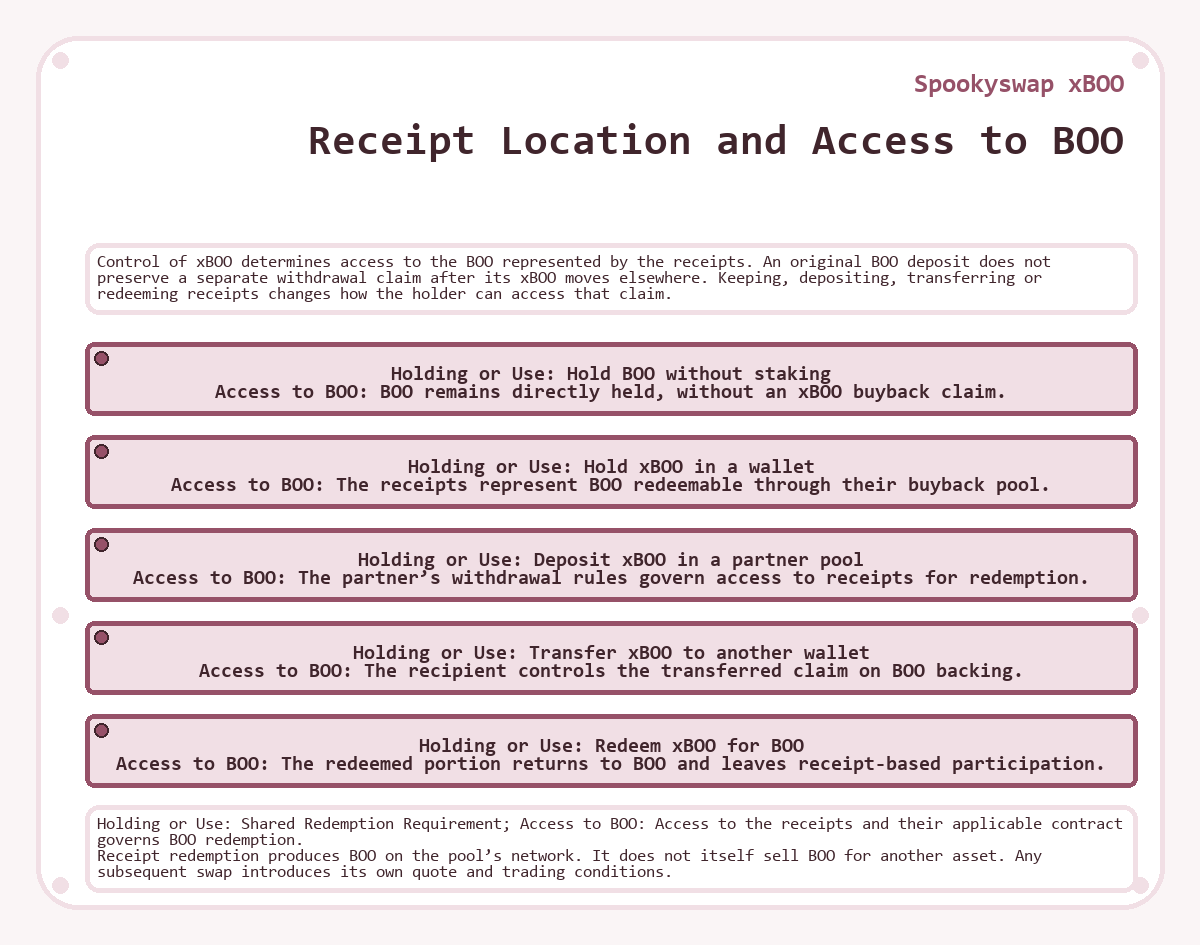
Receipt Location and Access to BOO
Control of xBOO determines access to the BOO represented by the receipts. An original BOO deposit does not preserve a separate withdrawal claim after its xBOO moves elsewhere. Keeping, depositing, transferring or redeeming receipts changes how the holder can access that claim.
- Holding or Use: Hold BOO without staking Access to BOO: BOO remains directly held, without an xBOO buyback claim.
- Holding or Use: Hold xBOO in a wallet Access to BOO: The receipts represent BOO redeemable through their buyback pool.
- Holding or Use: Deposit xBOO in a partner pool Access to BOO: The partner’s withdrawal rules govern access to receipts for redemption.
- Holding or Use: Transfer xBOO to another wallet Access to BOO: The recipient controls the transferred claim on BOO backing.
- Holding or Use: Redeem xBOO for BOO Access to BOO: The redeemed portion returns to BOO and leaves receipt-based participation.
Holding or Use: Shared Redemption Requirement; Access to BOO: Access to the receipts and their applicable contract governs BOO redemption.
Receipt redemption produces BOO on the pool’s network. It does not itself sell BOO for another asset. Any subsequent swap introduces its own quote and trading conditions.
| Holding or Use | Access to BOO |
|---|---|
| Hold BOO without staking | BOO remains directly held, without an xBOO buyback claim. |
| Hold xBOO in a wallet | The receipts represent BOO redeemable through their buyback pool. |
| Deposit xBOO in a partner pool | The partner’s withdrawal rules govern access to receipts for redemption. |
| Transfer xBOO to another wallet | The recipient controls the transferred claim on BOO backing. |
| Redeem xBOO for BOO | The redeemed portion returns to BOO and leaves receipt-based participation. |
| Shared Redemption Requirement | Access to the receipts and their applicable contract governs BOO redemption. |
Receipt redemption produces BOO on the pool’s network. It does not itself sell BOO for another asset. Any subsequent swap introduces its own quote and trading conditions.
Can Fantom xBOO Migrate Directly to Sonic?
The BOO migration from Fantom Opera to Sonic required xBOO holders to redeem their receipts for BOO before migrating. It opened on 26 December 2024 with a four-month window for a one-way conversion, and that original window has elapsed. Any subsequent route would require its own availability and eligibility terms.
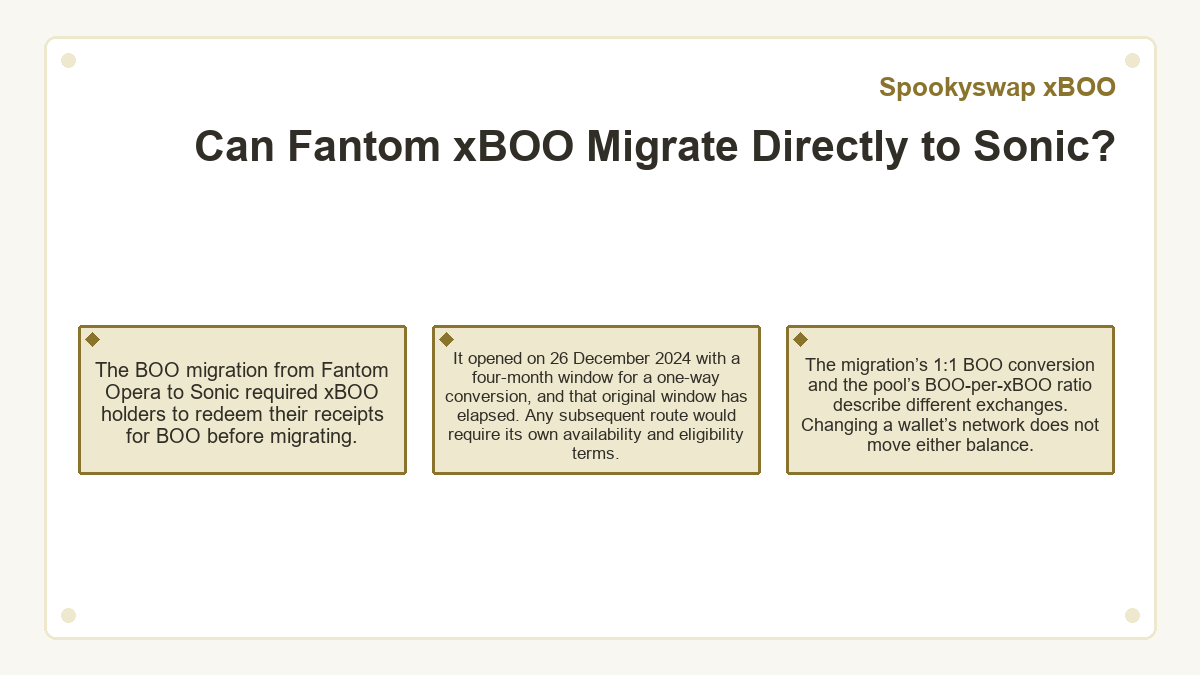
The migration’s 1:1 BOO conversion and the pool’s BOO-per-xBOO ratio describe different exchanges. Changing a wallet’s network does not move either balance.
Buyback Activity and Contract Dependencies
New buyback contributions can stop while existing receipts remain proportional claims on the BOO their pool holds. An unchanged xBOO count does not distinguish inactive conversion from successful additions to backing. A partner program introduces further dependence on its withdrawal contract. Deciding whether to deposit the receipt again means weighing its additional reward token against the conditions for getting xBOO back.
Details worth knowing about Spookyswap xBOO
Can I Redeem Only Part of My xBOO Balance?
You can redeem a selected amount of xBOO while keeping the remaining receipts. The selected portion converts at the applicable pool ratio. The receipts you retain continue representing their share of BOO backing.
Why Can xBOO Disappear From My Wallet After Partner Staking?
Deposited xBOO can sit in the partner pool’s contract rather than the wallet’s token balance. The staking position records the deposited receipts, so a reduced wallet balance can coexist with an intact recorded position. Access to those receipts follows the partner pool’s withdrawal rules.
Is an Earlier BOO Deposit Transaction Enough to Recover Lost xBOO?
An earlier deposit transaction does not substitute for the xBOO required to redeem BOO. A deposit record can establish transaction history, but it cannot authorize redemption of receipts the wallet no longer controls.
Does Redeeming xBOO Require a Separate Trading Pool?
Redeeming xBOO draws BOO from its buyback pool without requiring a buyer in a separate trading market. Selling the receipt through another pool is a different operation governed by that pool’s liquidity and quote. A market listing does not set the base redemption ratio.
Updated